What's going on with the Doral brush fires
If you're anywhere in western Miami-Dade or southern Broward right now, you already know something is off. The sky looks hazy, ash is landing on cars and patios, and the air has smelled like a campfire for days.
Two wildfires, the Quarry 2 Fire and the Well Fire, are burning thousands of acres of dry Everglades vegetation just west of Doral. As of June 17, 2026, they've consumed over 8,000 acres combined and are still only partially contained. The Quarry 2 Fire alone has burned roughly 7,500 acres at 30% containment.
These are not small fires. Krome Avenue is shut down from Tamiami Trail to US-27. Power went out along the NW 41st Street corridor. Thick smoke has pushed across Doral, Sweetwater, Hialeah, Miramar, Pembroke Pines, and Weston.
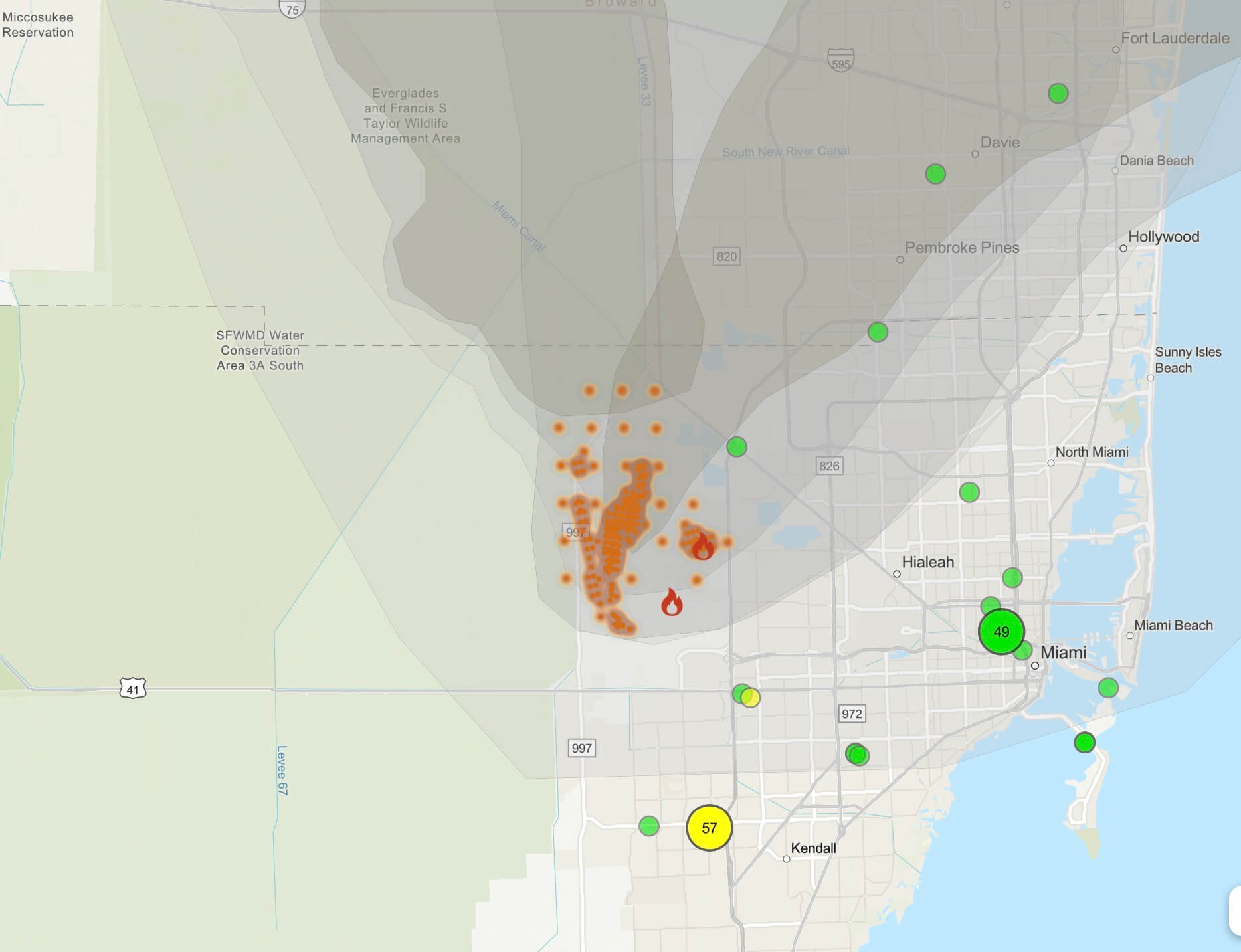 Radar view of the active fire zones and smoke plumes moving east across western Miami-Dade. The Quarry 2 Fire (north) and Well Fire (south) are burning just west of the Florida Turnpike near Doral.
Dry lightning during a stretch of extreme heat (temperatures near 108°F) ignited critically dry ground-level vegetation. The Everglades terrain is too wet and soft for heavy firefighting equipment, so crews have been fighting the blaze mostly with helicopter water drops. Progress has been slow.
The flames aren't directly threatening residential neighborhoods right now. But the smoke, falling ash, and terrible air quality absolutely are. And if you don't handle this the right way, the effects on your HVAC system, your roof, and your family's lungs can stick around long after the fires go out.
Why wildfire smoke is a bigger deal than it looks
Most people see haze and think it's just an annoyance. It's not.
Wildfire smoke is full of PM2.5, fine particulate matter about 30 times smaller than a human hair. Unlike visible ash or dust, PM2.5 slips past your nose and throat and gets deep into your lungs. From there, it can cross into your bloodstream and cause inflammation throughout your body.
The Miami heat makes this worse. When it's 100+ degrees outside, your body breathes harder and faster to cool down. That means you're pulling in more toxic particles per minute than you would in cooler weather, even if you're just walking to your car.
People who need to be especially careful:
- Children and elderly adults
- Pregnant women
- Anyone with asthma, COPD, or chronic bronchitis
- Anyone with heart disease
- Outdoor workers
If you can smell the smoke, it's already in your lungs. And regular cloth masks or surgical masks won't help. Only a properly fitted N95 or KN95 respirator actually filters PM2.5.
Close your fresh air intake and switch the fan to ON
Your AC is the first thing to deal with. Right now it's either cleaning your indoor air or actively making it worse, depending on how it's set up.
A lot of newer AC systems in Miami have a fresh air intake or make-up air damper that pulls in outside air for ventilation. Normally, that's fine. During a wildfire? It's pumping smoke straight into your ductwork.
Go to your thermostat or air handler and switch to 100% recirculate mode. If your system has a physical outdoor air damper on the air handler unit, close it by hand. That stops outside smoke from being mechanically drawn into your home.
Then find your thermostat's fan setting. Under normal conditions it's probably on "Auto," meaning the fan only runs when the AC compressor is cooling. Switch it to "ON." This keeps air circulating through your filter around the clock, even when the compressor isn't running. Your HVAC system basically becomes a 24/7 air filter for your house.
Upgrade to a MERV 13 filter
This is the single change that makes the biggest difference.
The basic fiberglass filter that came with your AC (usually rated MERV 1 to MERV 4) is built to catch dust and pet hair. That's it. It does nothing against smoke particles.
A MERV 13 filter uses denser, electrostatically charged synthetic fibers that can actually trap PM2.5 before it recirculates through your living space.
| Filter Rating | What It Catches | Smoke Protection |
|---|---|---|
| MERV 1 to 4 (Basic Fiberglass) | Large dust, lint, pet hair | None |
| MERV 8 to 10 (Pleated) | Mold spores, dust mites, pollen | Minimal |
| MERV 13+ (High-Efficiency) | PM2.5, smoke particles, bacteria | Effective |
| HEPA (Hospital-Grade) | 99.97% of particles 0.3 microns+ | Maximum |
One thing to know: MERV 13 filters restrict more airflow because they're denser. If your blower motor can't handle the added static pressure, it could freeze your evaporator coil or burn the motor out. If you're not sure your system can handle a MERV 13, call an HVAC tech before installing one. A broken AC during a heat wave and a smoke emergency is the worst possible timing.
Also, during heavy smoke a MERV 13 filter clogs fast. Check it every couple of days and replace it when the media turns dark brown or black. Stock up on extras if you can find them.
Set up a clean room if you're close to the fires
If you live in Doral, Sweetwater, or anywhere directly downwind, your central AC may not be enough on its own. Older homes with poor weather sealing let in particulates through every tiny gap.
You can set up one room in your house as a clean air zone:
- Pick an interior room with few windows and no exterior doors (a master bedroom with an ensuite bath works well)
- Seal gaps around the door frame with weather stripping or rolled-up towels
- Put a portable HEPA air purifier in the room, sized appropriately (more on that below)
- Run the purifier on the highest fan speed you can tolerate
- Use this room during the worst smoke hours, especially at night when stagnant wind traps particulates close to the ground
How to size an air purifier
The number that matters on a portable air purifier is the CADR (Clean Air Delivery Rate). It tells you how much filtered air the unit puts out, measured in cubic feet per minute.
A rough guideline: the CADR should be at least two-thirds of the room's square footage.
| Room Size | Minimum CADR |
|---|---|
| 150 sq ft (spare bedroom) | 100 CFM |
| 250 sq ft (standard bedroom) | 167 CFM |
| 300 sq ft (master bedroom) | 200 CFM |
| 400 sq ft (living room) | 267 CFM |
Stay away from any purifier that generates ozone as a byproduct. Ozone is a lung irritant and just makes the smoke effects worse.
Cut the indoor pollution you're generating yourself
Your filter can't keep up if you're adding pollutants inside the house at the same time. While the smoke is bad, avoid:
- Cooking on a gas stove (combustion byproducts add to indoor PM2.5; use a microwave, electric cooktop, or slow cooker)
- Burning candles or incense
- Smoking indoors
- Vacuuming without a HEPA-filter vacuum (regular vacuums kick fine particles back into the air)
- Using aerosol sprays (cleaning products, hairspray, air fresheners all add VOCs)
- Running a fireplace, even gas (it pulls in outside air through the flue)
Driving through the smoke
If you're commuting through western Miami-Dade right now, the smoke can drop visibility to near zero with no warning. Thick plumes drift across roads and create "brown-out" pockets where you can't see the car ahead of you.
A few things that help:
- Slow way down and leave more following distance than feels necessary
- Use low-beam headlights only. High beams bounce off the smoke particles and actually make it harder to see
- Switch your car's AC to recirculate (the button with the car icon and the circular arrow) so you're not pulling smoky air into the cabin
- Stay off Krome Avenue entirely. It's closed from Tamiami Trail to US-27
- The Florida Turnpike and NW 137th Avenue are absorbing the rerouted traffic, so expect delays
After the fires: what to clean and check
Once the smoke clears and the air quality comes back to normal, don't assume everything is fine. Ash and soot leave behind residue that causes problems if you ignore it.
Roof cleaning
Ash that settles on your roof isn't just ugly. On tile roofs especially, the residue holds moisture against the surface and gives algae and mold a head start, which Miami's humidity then accelerates. Left alone, you'll see black streaking and biological growth showing up within weeks.
A professional soft wash after the fires clears the ash, kills any mold or algae that's taken hold, and gets your roof's drainage pathways working properly again. That matters heading into peak hurricane season.
Get a free roof cleaning quote
More on why this matters: The Real Cost of Ignoring Roof Cleaning in Miami
AC coil cleaning
Your outdoor condenser has been pulling in smoky air for days. The coils are probably coated with fine soot and ash, which reduces heat transfer and makes the compressor work harder. That means higher electric bills and more wear on the unit.
Have an HVAC tech clean the condenser coils and check the evaporator coil for buildup. If you installed a MERV 13 filter during the fires, have them confirm the system is handling the airflow and swap in a fresh filter.
Pressure wash your exterior surfaces
Ash lands on everything: driveways, patios, pool decks, exterior walls. A pressure washing for hard surfaces and a soft wash for painted stucco and siding will clear the residue before it sets in or causes mildew.
If you're near the Everglades, think about defensible space
This fire should be a wake-up call for anyone living near the western edge of Miami-Dade, close to the Everglades or undeveloped land. The Quarry 2 and Well fires burned right up to the edge of developed areas. The weather conditions that produce these fires aren't going anywhere.
Defensible space is the idea of managing vegetation and combustible materials around your home so that an approaching fire has less fuel to work with. It also gives firefighters a safer zone to operate in if they need to defend your home. The Florida Forest Service and NFPA break it into three zones:
Zone 1: 0 to 5 feet from the house
This is where flying embers land, and embers cause most home ignitions during wildfires (not direct flames). They can travel miles ahead of the fire on strong winds.
- Pull dead vegetation, mulch, and leaf litter away from the first 5 feet around the house
- Swap wood mulch for gravel, stone, or decomposed granite against the foundation
- Clear dead palm fronds, pine needles, and debris from roof valleys and gutters
- Make sure no branches or shrubs are touching the walls or hanging over the roof
- Move firewood, propane tanks, and anything combustible at least 30 feet away
Zone 2: 5 to 30 feet out
The goal here is to break up continuous fuel so fire can't build momentum on its way toward the house.
- Space trees so canopies don't overlap (at least 10 feet between crowns)
- Remove low shrubs and brush that act as "ladder fuels," letting ground fire climb into tree canopies
- Keep grass mowed to 4 inches or less
- Prune lower tree limbs up to 6 to 10 feet off the ground
Zone 3: 30 to 100+ feet
This outer perimeter slows an approaching fire down before it reaches the zones closer to your house.
- Thin out dense tree clusters
- Remove dead trees and heavy brush buildup
- Keep fire-resistant groundcover
Pick plants that don't catch fire easily
This part matters more than most people realize. Plants with resinous sap (pines, saw palmetto, wax myrtle, juniper) contain volatile oils that burn fast and hot. Broadleaf plants with high moisture content absorb heat instead of igniting.
| Highly Flammable (Remove or Avoid) | Fire-Resistant Alternatives | |
|---|---|---|
| Trees | Pines, Red Cedar, Italian Cypress | Live Oak, Jacaranda, Magnolia, Crape Myrtle, Sycamore |
| Shrubs | Saw Palmetto, Wax Myrtle, Juniper, Yaupon Holly | Coontie, Beautyberry, Viburnum, Agave, Aloe |
| Why | Resinous sap, needle-like leaves, heavy dead foliage buildup | High moisture content, broad fleshy leaves, low resin |
Official resources worth bookmarking
Social media rumors move faster than facts during something like this. Stick to official sources for decisions about your safety:
EPA Fire and Smoke Map
PM2.5 readings by zip code, color-coded health recommendations, and smoke plume forecasts. This link opens centered on the Miami-Dade fire zone. Bookmark it.
Florida Forest Service active wildfire dashboard
Interactive map with fire size, containment percentage, and perimeter movement. This is where the official acreage and containment numbers come from.
Miami-Dade emergency alerts
Sign up for push notifications through the county's system. You'll get updates on road closures, evacuation orders, and air quality warnings sent directly to your phone.
What to do right now (the short version)
If you just need the checklist:
- Set your HVAC to recirculate, switch the fan to ON, and install a MERV 13 filter
- Set up a clean room with a HEPA purifier if you're directly downwind of the fires
- Stop burning candles, cooking on gas, or running anything that adds particles to your indoor air
- Use recirculate mode in your car and stay off Krome Avenue
- Once the smoke clears, schedule a roof cleaning and an AC coil cleaning
If your property borders undeveloped land, start thinking about defensible space and swapping flammable landscaping for fire-resistant plants. These fires won't be the last.
We'll update this post as the situation changes.
Need help getting your home back to normal?
Miami Home Service connects homeowners across Doral, Coral Gables, Kendall, Pinecrest, Hialeah, and all of Miami-Dade with licensed local pros. Post-fire roof cleaning, AC service, pressure washing, ash and smoke damage cleanup: get a free quote and we'll match you with someone who can help.
Related guides: